A legend
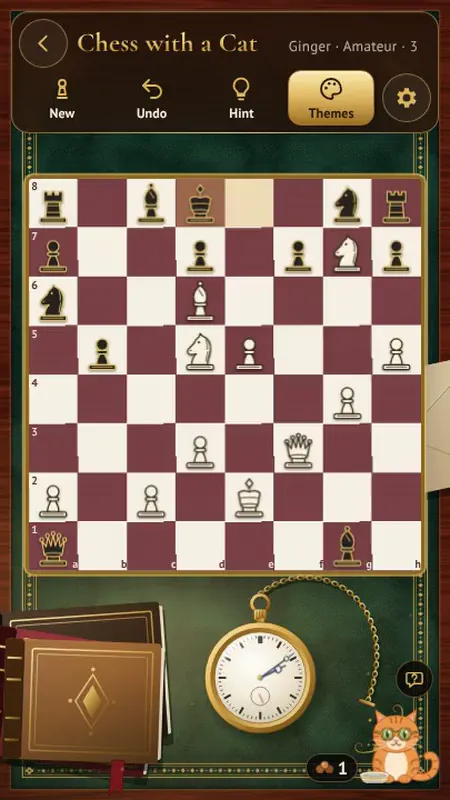
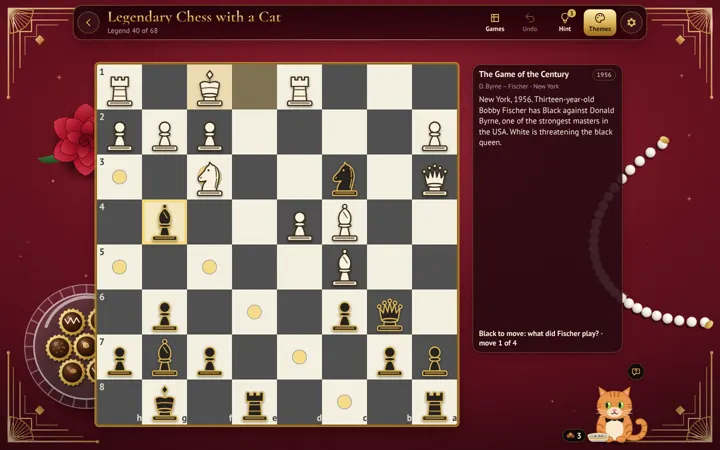
The board shows a position from a famous game, and the plaque beside it says who played, where and when, and what is going on. You play for the hero of the game: if they had Black, the board is turned around.
Anderssen's Immortal Game, Morphy's Opera Game, 13-year-old Fischer's Game of the Century, Short's king march — 68 famous moments from real chess games. The cat tells you who played and why the game is remembered, and you look for the move the champion made.
The goal is to find the move the champion played in the real game — and if the combination is longer, all of its moves, from one to four.
The board shows a position from a famous game, and the plaque beside it says who played, where and when, and what is going on. You play for the hero of the game: if they had Black, the board is turned around.
Tap your piece, then the square to move it to. Find the champion's move and the opponent replies exactly as in the real game — then look for the next move.
Not only the champion's move counts: an equally strong one does too. Such moves were checked in advance by a chess program. The cat says “your move is just as good, but in the game it was…”, and the game's move is played on the board, so history goes as it really did. On the last move of a mating legend, any mate counts.
A wrong move is not played. From the second try the cat hints which piece moves, and then whether it gives check, captures or is a quiet move.
Yes. Play right away, with nothing to install and no sign-up. Solved legends and the game in progress are saved automatically.
Knowing how the pieces move is enough. Each legend has a level from Novice to Master: Légal's Mate or the Opera Game are fine for beginners, while Rubinstein's or Nezhmetdinov's combinations will make a strong player think.
Yes. The moves come from open chess databases, most games are cross-checked against two sources, and the key moves are verified by a chess program.
Yes. Open the “Games” window: all 68 legends are there, by chapter, with the year, the players and the level. “Next” takes you to the next unsolved one.