Dice and moves
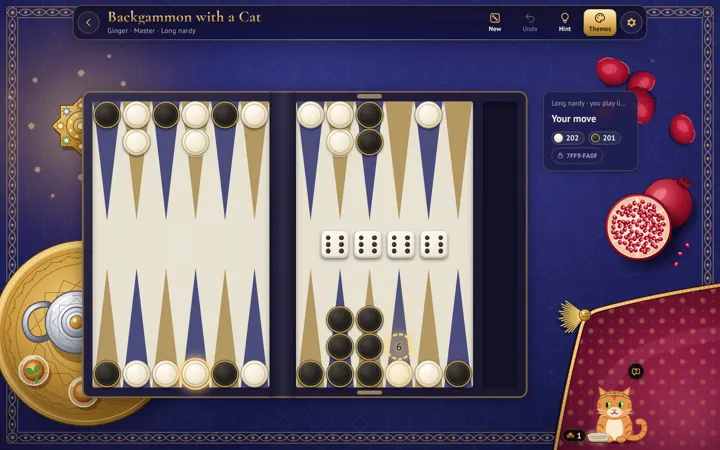
You roll two dice and move checkers forward by the numbers shown. A double gives four moves. You must play as many dice as possible, and if only one of the two can be played, it has to be the larger.
Long nardy and backgammon against a cat: four levels of strength, two players on one screen and provably fair dice you can check after the game. Free.
The goal is to bring all 15 checkers home and bear them off first. If your opponent hasn't borne off a single checker by then, it's a gammon ("mars") and the win counts for two points.
You roll two dice and move checkers forward by the numbers shown. A double gives four moves. You must play as many dice as possible, and if only one of the two can be played, it has to be the larger.
Both sides travel the same way round, starting from opposite corners. There is no hitting: you can't land on a point held by an enemy checker. Only one checker may leave the head per turn (two on a first-turn 6-6, 4-4 or 3-3). You may not build a wall of six points in a row unless an enemy checker is already ahead of it.
Classic backgammon: the two sides move towards each other. A point held by two or more enemy checkers is closed. A lone enemy checker can be hit: it goes to the bar and must re-enter before any other move.
When all 15 checkers are home you bear them off: a die removes a checker from the point at the matching distance from the edge. If there are none further back, a larger die removes the farthest one.
Yes. Play right away, with nothing to install. A game in progress is saved — each mode keeps its own.
In long nardy you can't hit, so the game is a race built around blocks. In backgammon you can hit, checkers go to the bar and the play is sharper. New players start with long nardy against Amateur; pick the variant and mode in the "What shall we play?" window.
Before the first move the panel shows a fingerprint of eight characters. After the game open the "Fair dice" window to see the key. Any SHA-256 calculator will confirm that the fingerprint matches the key and that every roll was derived from it. The rolls don't depend on your moves.
You can undo the steps of your own turn until you press "Done". A whole turn can't be undone after the cat has replied: that would let you peek at its move and your next roll.