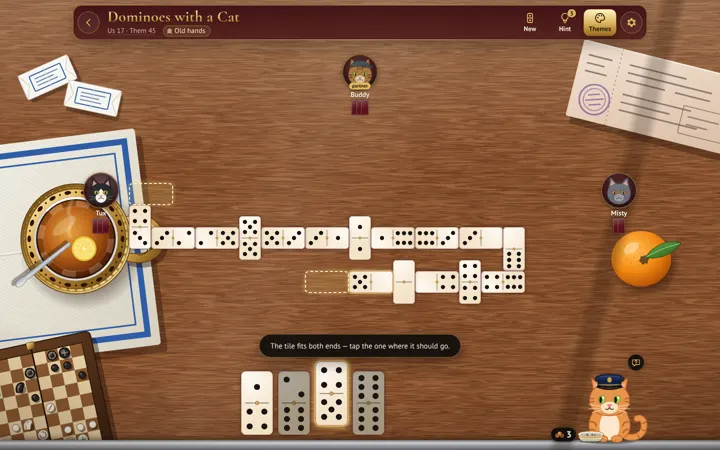
Dominoes with cat neighbours: Kozel for four, partners against partners, or Classic one-on-one with a boneyard. Games run to 101 points and the neighbours play on four levels. Free.
The goal is to play out all your tiles before the others and not reach 101 points: whoever gets to 101 first loses the game — they are the "goat" (kozel).
1
Tiles and turns
The double-six set has 28 tiles, each with two halves of 0–6 pips. A tile goes onto an end of the chain showing the same number; a double is laid crosswise. Play goes clockwise. The first hand begins with whoever holds 1:1, playing that tile.
2
Kozel: partners
Four play: you and the cat Kuzya against two neighbours. Everyone gets 7 tiles and there is no boneyard. If you can't play, you knock ("Knock!") and the turn passes on.
3
Classic: one-on-one
You against the neighbour across the table: 7 tiles each and the other 14 in the boneyard. If you can't play, draw tiles one at a time until one fits. When the boneyard is empty, you knock.
4
Scoring
A hand ends when someone plays their last tile ("Domino!"), or when nobody can move — a "fish" (blocked game): the side holding fewer pips wins. The losers score the pips left on their tiles. A tie is "eggs": nobody scores, and those points go to whoever loses the next hand.
Tips to win more often
Play doubles early: they are heavy in hand and it hurts to be stuck with one at the end of a hand.
Get rid of heavy tiles first: if the hand ends in a fish, you score what is left in your hand.
Remember who knocked on what: that neighbour has none of those numbers. Close those ends to them, and in Kozel don't leave your partner the numbers they knocked on.
Keep several tiles of one number: you will always have a move, and you can hold that end for yourself.
Not sure? Ask the cat: he points to a tile and tells you why it is a good one.
What makes dominoes handy
The neighbours don't peek
Each cat decides only from what it sees from its seat: its own tiles, the chain, how many tiles the others hold, and who knocked on what. It never sees other hands, and that is covered by tests.
Four levels of neighbours
The Beginners, Pushok and Murzik, play almost at random; the Amateurs, Murka and Barsik, play doubles and heavy tiles early; the Seasoned, Vaska and Dymka, remember who knocked; and the Masters, Markiz and Nochka, work through the possible layouts of hidden hands. The next level opens after two wins.
A hint with a reason
The cat shows a move and tells you why: it's your last tile, the next neighbour will have nothing to play, it's better to get a double out early, or in Kozel, we won't leave our partner what they knocked on.
Like a real table
Tap a tile to lift it, tap again to place it. Playable tiles are lighter than the rest and the spots at the ends are marked with a golden dashed line. There is no undo, just like at a real table.
Questions and answers
Is it free?
Yes. Play right away, with nothing to install. A game in progress is saved.
How is Kozel different from Classic?
Kozel has four players, partners against partners: you and the cat Kuzya against two neighbours, 7 tiles each and no boneyard — if you can't play, you knock. Classic is one-on-one: 14 tiles sit in the boneyard, and when you can't play you draw until one fits.
What are a "fish" and "eggs"?
A "fish" is a hand in which nobody can move; the side with fewer pips in hand wins it. "Eggs" is a tie on pips: nobody scores, and those points go to whoever loses the next hand.
How do I unlock stronger neighbours?
The next level opens after two wins over the current one, in either mode. You can always drop back to an easier level.