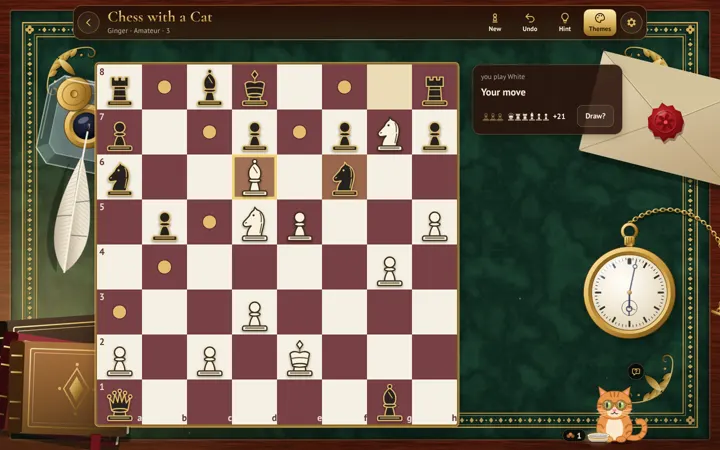
Classic chess: a game against the computer on ten levels, two players on one screen and 500 puzzles. The cat suggests the best move and explains it in plain words.
The goal is checkmate: attack the opponent's king so that there is no way to defend it.
1
The pieces
Each side has a king, a queen, two rooks, two bishops, two knights and eight pawns; White moves first. A rook moves along ranks and files, a bishop along diagonals, a queen both ways, a knight in an L-shape and it can jump over pieces, a king one square.
2
Pawns
A pawn moves one square forward (two from its starting square) and captures diagonally forward. When it reaches the last rank it promotes: the game asks you to pick a queen, rook, bishop or knight. En passant works too.
3
Check and checkmate
Check means the king is under attack. Your next move must deal with it: step away, block, or capture the attacker. You may never leave your own king in check. If there is no way out, it is checkmate and the game is over.
4
Castling and draws
Castling: the king moves two squares towards a rook and the rook jumps over to its other side — if neither has moved, the squares between are empty, and the king is not in check and does not cross an attacked square. The game declares draws by itself: stalemate, threefold repetition, 50 moves without a capture or pawn move, or when mate is no longer possible.
Tips to play better
Start with the centre: pawns to e4 or d4, then bring out knights and bishops. Don't move one piece again and again while the others stay at home.
Castle early: the king is safer behind its pawns and the rook joins the game.
Before every move ask: what is attacking my pieces now, and which of them are unprotected? Most beginners' games are lost to a piece given away for nothing.
Don't bring the queen out too early: it is easy to chase away and you lose time.
Solve puzzles: forks, pins, mate in two. A few minutes a day teach you to see the board better than games alone.
What makes chess handy
Ten levels of strength
Weak levels make human mistakes: the first one doesn't notice that a piece will be taken in reply, the tenth plays at full strength. Eight steps lie in between, so everyone finds an opponent of the right size.
The cat explains the move
A hint is an arrow on the board, and the cat says why the move is good: a fork, a pin, "we take the queen, nobody protects it". The pieces involved are highlighted.
A blunder warning
If a move gives away a piece or walks into a mate, the cat tells you before it is played: take it back or keep it. He ignores small inaccuracies, and the warnings can be switched off in the settings.
Puzzles and game review
500 puzzles from the open Lichess database, from mate in one to tough combinations, and a new puzzle every day. After a loss, "Where was the mistake?" shows the move where things went wrong and a stronger one.
Questions and answers
Is it free?
Yes. Play right away, with nothing to install. A game in progress is saved, so you can come back to it later.
Can two people play?
Yes. Choose "Two players" in the game mode window and take turns on one screen — a computer, tablet or phone.
Which level should I pick?
Just learning the moves? Start with Beginner (levels 1–3). If you can play, take Amateur or Seasoned. Master (levels 9 and 10) almost always finds the best move. Win at a level, then move up.
Where do the puzzles come from?
From the open Lichess puzzle database: positions from real games, each with its own rating — from about 450 for the first puzzles to 2400 for the last. You have to find a mate in two or the strongest move. If you slip, the cat hints at the theme to look for.