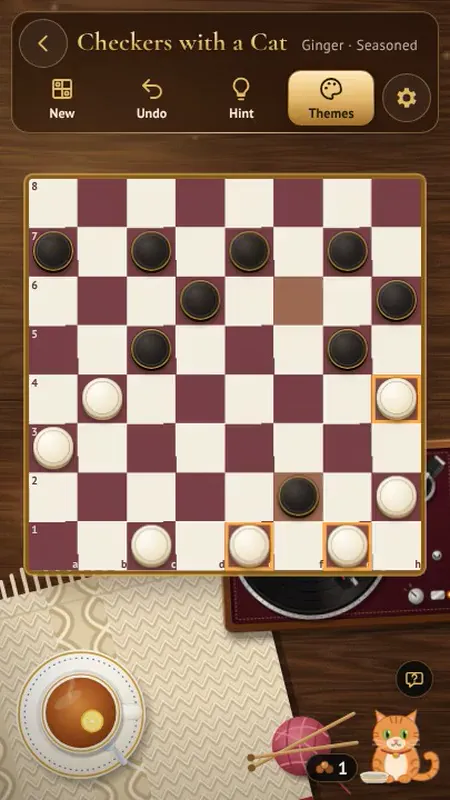
The setup
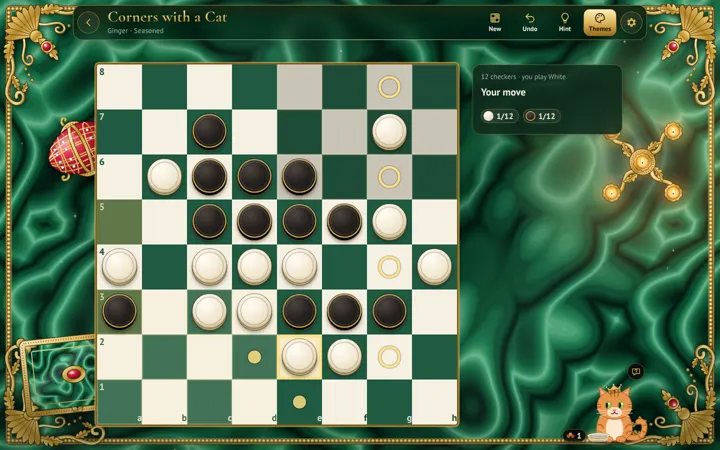
White starts in the bottom-left corner, Black in the top-right, and White moves first. The classic setup is 9 pieces in a 3×3 square. You can also play with 12 pieces (a 4×3 block) or 16 (a 4×4 square).
Corners is a race: bring your pieces from one corner of the board to the opposite one before your opponent does, hopping over their neighbours. Here you can play against the cat on four levels, share one screen with a friend and solve 300 puzzles.
The goal is to be first to move all your pieces into your opponent's home: the opposite corner of the board.
White starts in the bottom-left corner, Black in the top-right, and White moves first. The classic setup is 9 pieces in a 3×3 square. You can also play with 12 pieces (a 4×3 block) or 16 (a 4×4 square).
On your turn a piece can step to an adjacent empty square — forward, back or sideways. In the "With diagonals" variant diagonal steps are allowed too.
Instead of stepping, a piece hops over an adjacent piece — yours or theirs — onto the empty square right behind it, and may keep hopping. Such a chain, a ladder, carries a piece far in a single move. Steps and hops can't be mixed in one move, and no piece is ever captured.
If White gets home first, Black still gets one last move; if Black makes it too, the game is a draw. To stop anyone from guarding their home, after the 40th move a player who still has a piece in their own home loses. No legal moves is a loss. Threefold repetition is a draw.
Yes. Play right away, with nothing to install. A game in progress is saved.
There is no fighting: nothing is captured. It's a race, and the winner is whoever gets their pieces to the far corner first. The board and pieces are the same, but the moves are different: steps and hops over any piece.
Start with the classic 9 pieces. With 12 and 16 pieces the game is longer and harder, and diagonal moves give you more freedom and more options.
Move the white pieces onto the marked squares in the corner within a set number of moves, while the black stones stay put and serve as footholds for jumps. The number is the minimum possible — it can't be done faster. Ran out of moves? Press "Retry". Stuck? A hint shows the next move.