A move
Tap a tile in the same row or column as the empty square, and it slides over along with every tile in between. Each tile that moves counts as a move. You can also swipe across the box, or use the arrow keys or W A S D on a computer.
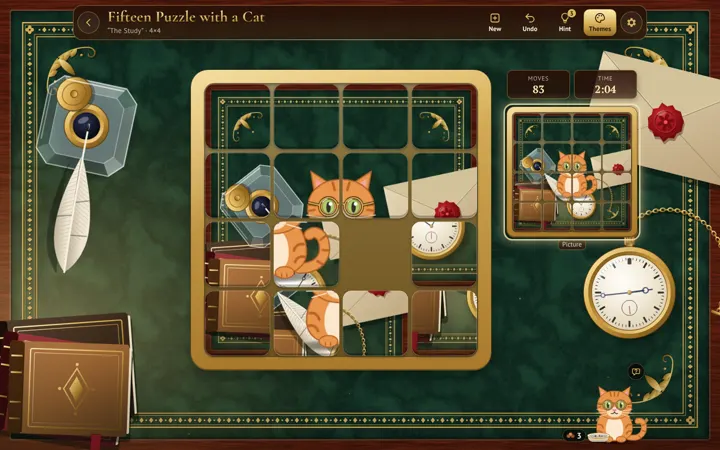
The classic fifteen puzzle: numbered tiles in a box and one empty square. Slide the tiles until they line up in order. Not sure how to solve it? The cat teaches you the real way, row by row. Every layout can be solved, and it’s free.
The goal is to put the tiles in order, left to right and top to bottom, with the empty square in the bottom right corner.
Tap a tile in the same row or column as the empty square, and it slides over along with every tile in between. Each tile that moves counts as a move. You can also swipe across the box, or use the arrow keys or W A S D on a computer.
Undo takes back a whole move, and the move counter too. A tile that’s in its place is marked with a dot.
The clock runs only while a game is under way and the table is in view, and only matters for records — you can hide it in the settings. Move and time records are kept for each box size.
Puzzles ask you to arrange the tiles in order, as a snake, a spiral or in columns. The best solution is worked out in advance: match it for three stars, stay within one and a half times it for two, otherwise one.
Yes. Play right away, with nothing to install. A game in progress is saved.
No: swap two tiles of a solved box and it can no longer be solved. But every layout in the game can be — the “14–15” lesson explains why.
Start with 3×3 — just eight tiles. Once you’ve got the row-by-row method, move on to the classic 4×4, and then to 5×5 and 6×6.
Yes: choose two players in Race — two boxes with the same layout appear on screen, and whoever finishes first wins.