A turn
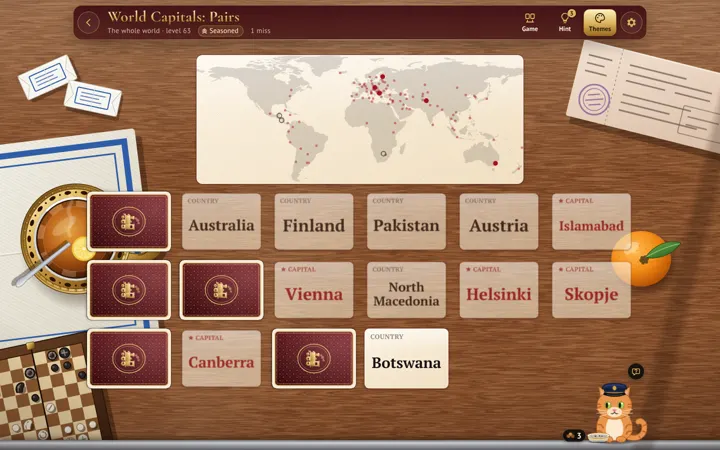
All cards lie face down. A tap turns one over, the next tap turns a second; two open cards make one turn. A label at the top says “country” or “★ capital”, and capitals are written in red.
Memory for anyone who loves geography. Some cards show countries, others show capitals: turn over a country and its capital, the pair stays face up, and a light comes on on the map. Play one part of the world or all of it, and read the names in English or nine other languages. No timer, free.
The goal is to find every country-and-capital pair with as few misses as possible.
All cards lie face down. A tap turns one over, the next tap turns a second; two open cards make one turn. A label at the top says “country” or “★ capital”, and capitals are written in red.
A country and its capital make a pair: both cards stay face up and the capital lights up on the map above the table. Not a pair — the cards stay open for a little over a second and turn back.
Novice (levels 1–14): the best-known countries, and all cards are shown for 3 seconds at the start. Amateur (from 15): no peeking. Seasoned (from 40): rarer countries and look-alike names. Master (from 100): every country and 10 pairs.
A miss is when the right card had already been seen and you opened another, or reopened a card you knew was wrong. Opening a new card at random is not a miss. No misses earns three stars, up to a third of the pairs two, more than that one. There is no timer.
Yes. Play right away, with nothing to install. Levels in progress and collected countries save themselves.
A single 10-pair layout for all players on that day: countries from all over the world and one pair of look-alikes. You can complete it once and a new one arrives tomorrow.
Yes: pick the language of names in the Game window. The countries on each level stay the same, with the English name in small print under each one. Switch back to English and you carry on where you left off.
The game is about capitals, not disputed territories: the map shows only continents and capital dots. That also keeps it clear on a small screen.